
Human-in-the-Loop Orchestration: Rethinking AI, Research, and Human Governance
A multimodal academic exploration of Professor Moustapha Diack’s Human-in-the-Loop Orchestration Model for AI-assisted research, education, and responsible knowledge production.

The rapid rise of generative Artificial Intelligence has transformed how we write, research, teach, and communicate knowledge. Yet many current approaches still frame AI as a transactional tool operating through isolated prompts and automated outputs.
This publication introduces a different vision.
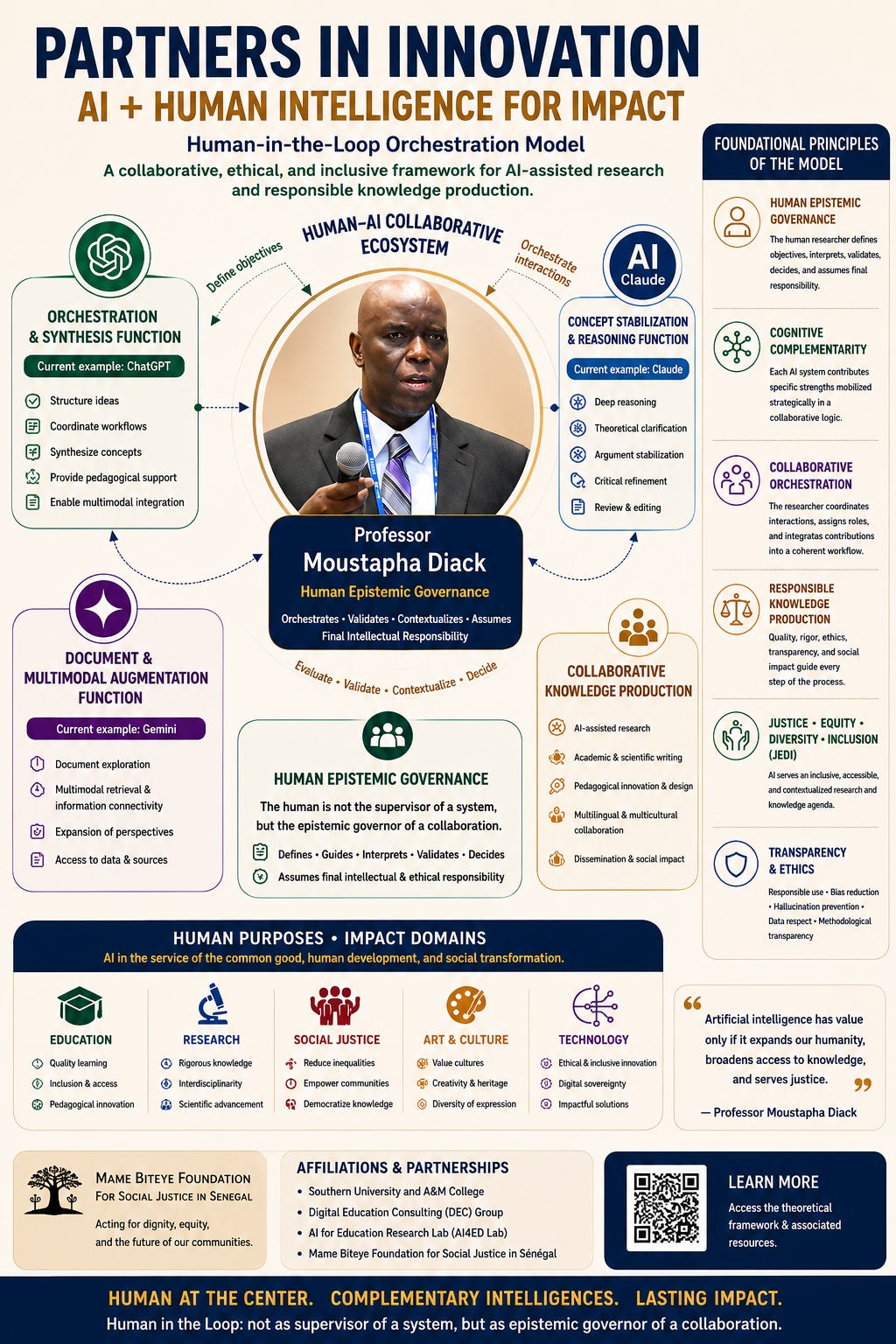
The Human-in-the-Loop Orchestration Model developed by Professor Moustapha Diack proposes that Artificial Intelligence systems should not replace human reasoning, but instead function as complementary cognitive partners operating under human epistemic governance.
Rather than centering automation alone, the model emphasizes:
human responsibility;
collaborative orchestration across multiple AI systems;
multimodal knowledge production;
ethical and transparent workflows;
and Justice, Equity, Diversity, and Inclusion (JEDI).
This post accompanies the release of an academic podcast and multimodal dissemination ecosystem built around the model.
Summary of the Paper
The Human-in-the-Loop Orchestration Model proposes a collaborative framework for AI-assisted research and responsible knowledge production.
The model argues that Artificial Intelligence systems should not be treated as autonomous research authorities, but rather as specialized cognitive partners coordinated by a human researcher who remains responsible for interpretation, validation, contextualization, and ethical accountability.
Within this framework:
ChatGPT supports orchestration and synthesis;
Claude contributes conceptual stabilization and deep reasoning;
Gemini and NotebookLM facilitate multimodal transformation and educational dissemination.
The model also emphasizes:
multilingual knowledge production;
African and Francophone intellectual sovereignty;
multimodal educational ecosystems;
and ethical AI governance grounded in human judgment.
The framework ultimately reframes AI not as a replacement for human expertise, but as an ecosystem of complementary intelligences operating under human governance.
The canonical French version of the manuscript is openly available through Zenodo under a Creative Commons license.
https://doi.org/10.5281/zenodo.20219014
Professor Moustapha Diack
Science/Mathematics Education Program (SMED)
College of Science and Engineering (CSE)
Southern University and A&M College
Executive Director, DEC Group
Director, AI for Education Research Lab (AI4ED Lab)